The Real Problem Is Not Weak Science
Why Education Alone Does Not Work
The Narrative-Evidence Gap
Curiosity Is Not Adoption
Why Hype Is So Expensive
Claim calibration
Check a claim before it travels from your pitch deck to a pack or press release.
A field guide to food biotech commercialisation
How food innovation startups turn scientific promise into trust, trial and traction.
A promising product gets a meeting. What gives someone a reason to buy it again?
Adam M. Adamek connects food science, consumer behaviour and commercial decisions. Use the questions on your product, your claims and your next launch.
English-language digital edition. Direct checkout is being prepared.
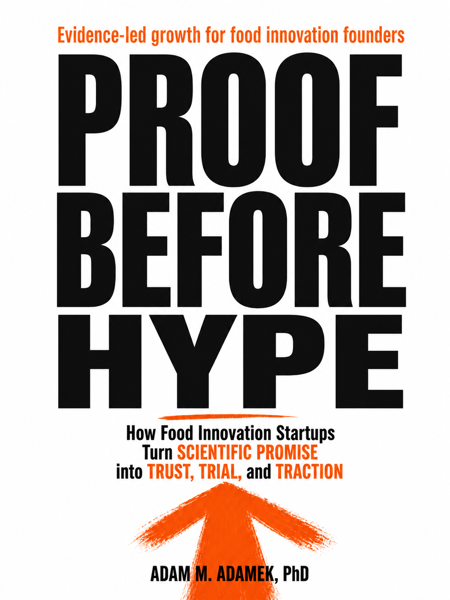
By Adam M. Adamek, PhDFoodEdge Editor-in-Chief
50 chapters. 10 parts. 6 appendices.Food biotech & nutrition intelligence
Getting them to come back asks something else of the product.
Food biotech teams have to explain unfamiliar ingredients, substantiate claims and make an offer that belongs in an ordinary meal. A good scientific explanation cannot do all of those jobs on its own.
Proof Before Hype puts the questions together: what you can prove, what the buyer can recognise and what the product actually delivers.
The book offers frameworks for investigation and discussion. It does not promise a particular launch, investment or sales outcome.
Start with the work you need to move forward. The same product raises different questions for different teams.
Use the book to separate scientific promise from the reasons a buyer might try, trust and choose the product again.
Connect technical evidence with the product experience, manufacturing questions and claims your colleagues need to substantiate.
Examine naming, packaging, price and context from the buyer’s side of the decision.
Use the narrative-evidence diagnostic and investor stress test to structure a more specific conversation with a company.
Explore how ingredient credibility, familiar food occasions and product experience come together in an offer.
A vocabulary and a set of questions to use on the documents and product decisions already on your desk.
Identify where the promise goes further than its supporting proof.
Decide what you can substantiate and what still needs investigation.
Examine naming, price, sensory experience and the eating occasion.
Use the relevant worksheet to make a decision and assign the next action.
The ten parts move from food behaviour and trust into language, positioning, sensory experience, stakeholder conversations and working tools.
Chapter 12 separates five layers. Strength in one area does not answer every question in another.
Start with the result, its method and its limits. An explanation of a mechanism is not the same thing as evidence for every product claim.
Look beyond the successful sample. The book connects trust with reproducibility, quality and the practical work of supplying the product.
Keep the product, use and market in view. A clearance or review in one context does not answer every question about another.
Consider the price alongside the comparison set, eating occasion and value the buyer can recognise.
Examine familiarity, ritual and context. The next meal is a different decision from an abstract question about a new technology.
The Trust Stack is the author’s discussion framework, not a certification, regulatory checklist or validated scoring system.
An excerpt from Chapter 1, “The Real Problem Is Not Weak Science”.
The first purchase is curiosity.
The fifth purchase is belief.
Most food biotech companies are still designing for the first one. They spend fortunes making people interested. They spend almost nothing making people confident. That is a strange way to build a food business, and it is the default across precision-fermented dairy, cultivated seafood, and biofortified grains.
Founding teams built for discovery. Decks built for amazement. Go-to-market built for the person who already wants to try something new.
And then the trial happens. The product is interesting. The fifth purchase never comes.
I have sat in investor rooms that went quiet at the same moment. The science slides were strong, the data clean, the regulatory path mapped. Then someone asked a question the founder had not prepared for.
What makes someone buy this the fifth time?
The silence is not confusion. It is recognition. The whole presentation had been built to get someone to try. Nothing had been built to get someone to stay.
This is the central commercial challenge in food biotech. It explains more failed launches and more stalled categories than any regulatory delay ever will.
Practical reference material included in the book. Work through it with your own evidence, product context and team.
Check a claim before it travels from your pitch deck to a pack or press release.
Review scientific, manufacturing, regulatory, price and cultural trust separately.
Examine the meaning a product name carries before the explanation begins.
Put your current sentences through the book’s Copy Test.
Identify the questions your story and evidence still need to answer.
Follow the research, regulatory material and company sources behind the chapters.
Two digital formats for different ways of reading and working. The edition is in English.
Written at the intersection of food science, product development and commercial decision-making.

Editor-in-Chief and author at FoodEdge, an OmniNevia publication. His work connects food biotech and nutrition evidence with product and investment decisions.
Proof Before Hype focuses on trust, trial and commercialisation. His companion book, FoodTech After the Hype, examines the operating demands of building a food business.
About the book, the formats and direct purchase.
The book is anchored in food biotech, including plant-based products, biomass and precision fermentation, cultivated meat and hybrid products. It also discusses ingredient credibility and functional nutrition.
The book is written for commercial and technical teams. It connects research and product questions with business decisions, rather than teaching a laboratory protocol.
No. The appendices are reference material and worksheets inside the book. A separate software subscription is not part of this offer.
No. This page is being prepared for a direct digital purchase. Its PDF and EPUB actions stay on this site. No payment is currently collected.
Not yet. The price is €8.40 including VAT for PDF + EPUB. Checkout, licence and file delivery are being completed before direct purchase is enabled. The page does not take orders, reserve a price or charge a card.
A team licence has not been offered on this page. Multi-reader rights and terms will be stated separately before purchase is enabled.
The English digital edition brings the argument and working reference material together.
Direct digital sales are being configured. No launch deadline, discount or guaranteed result is implied.
English digital edition · PDF + EPUB
€8.40
PDF + EPUB for one reader. Price includes VAT. Direct checkout is being prepared.
No payment is collected. There is no Amazon redirect for PDF or EPUB.
Read the excerpt first